

Traditional Life
From prior exploitation to partnership with nature
Traditional Lifestyles
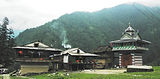
Villages on GHNP’s western periphery preserve some of the most intact mountain architecture in the Western Himalaya. The Kath‑Kuni style uses interlocked deodar wood and stone to build resilient homes and temples that have withstood earthquakes and cloudbursts. Water mills still turn along clear streams; handlooms sit in sunlit verandas; barns and granaries breathe with the seasons.

A traditional house in Tirthan Valley

Juwari in Shenshar area of Sainj Valley
Daily life balances continuity and change. Women weave on outdoor looms. Ground floors serve as cowsheds, with living spaces above opening to sweeping mountain views. Traditional foods include rice and wheat, millets like buckwheat and barley, maize, amaranth and finger millet, alongside seasonal fruits and meat. Cooperative labour traditions such as Juwari—villagers planting paddy together, keep fields vibrant, especially with the locally loved Lal Dhaan (red rice). With road connectivity and declining availability of timber, cement and iron have entered new construction, and public distribution has introduced faster-growing grain varieties. The result is a landscape where tradition adapts rather than disappears.
Juwari — joint work, shared harvest, stronger community.

Water mills in ecozone, Tirthan Valley

A barn in Tirthan Valley
%20from%20Lapah%20village%20in%20GHNP%20ecozone_JPG.jpg)
Eleusine coracona (Finger millet) from Lapah village in GHNP ecozone
%20millet%20from%20Lapah%20village%20in%20GHNP%20ecozone_JPG.jpg)
Amaranthus hybridus (Amaranth) millet from Lapah village in GHNP ecozone